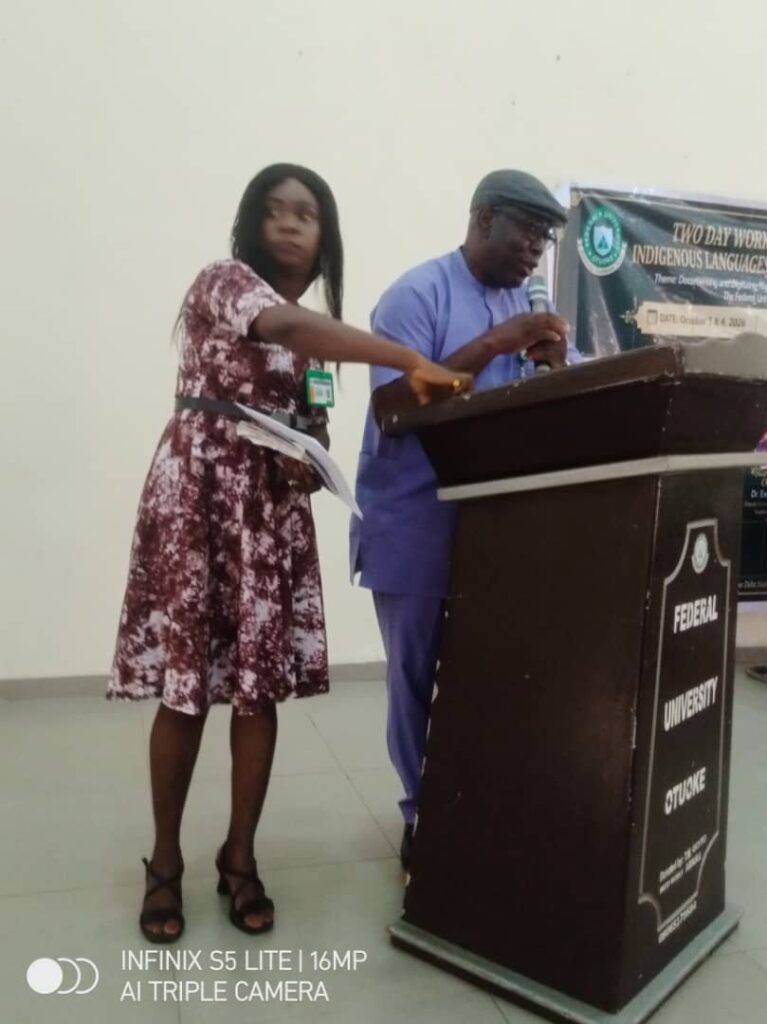
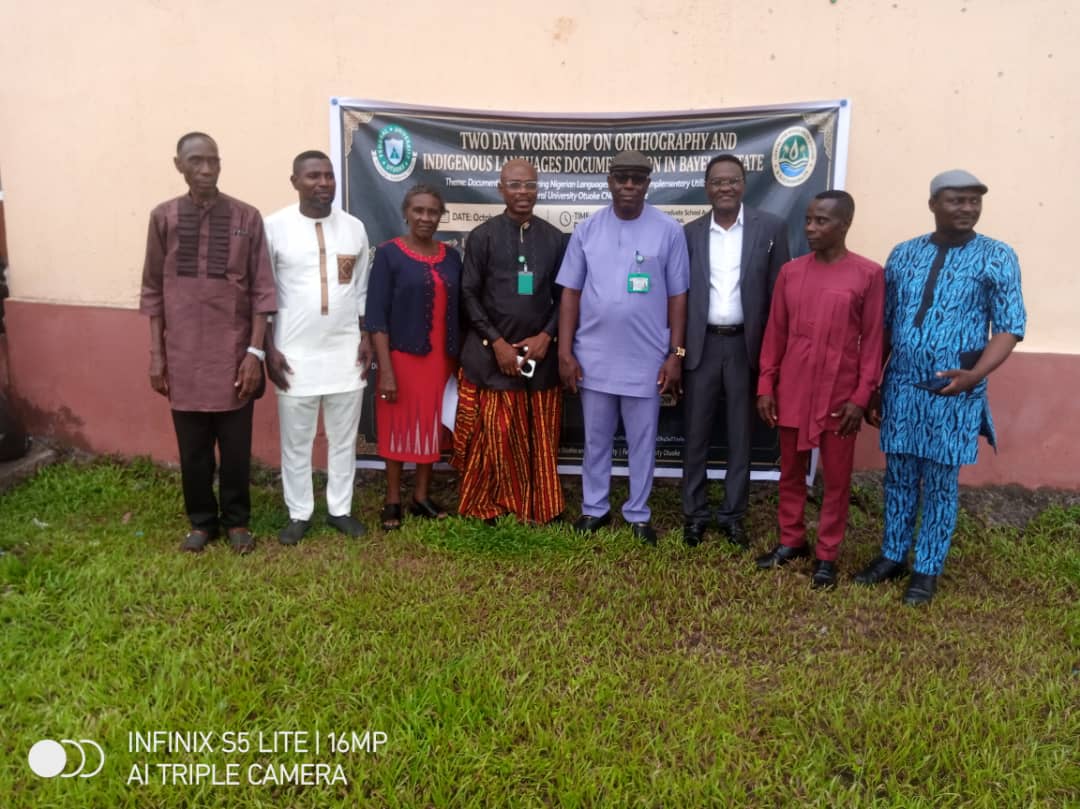
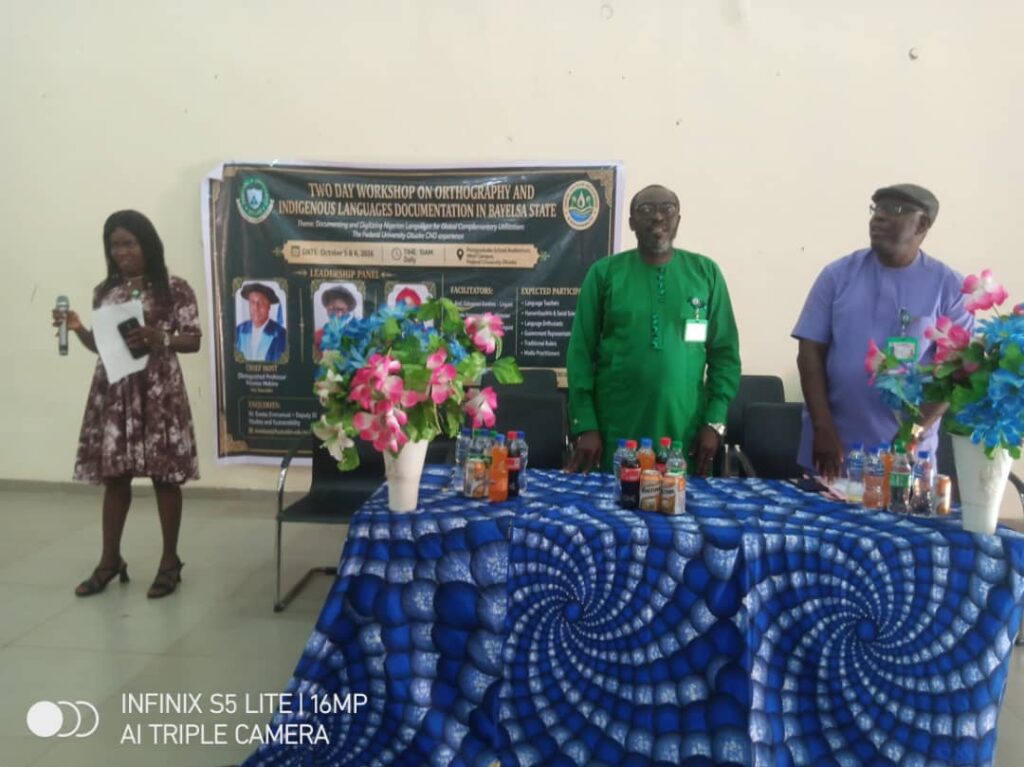
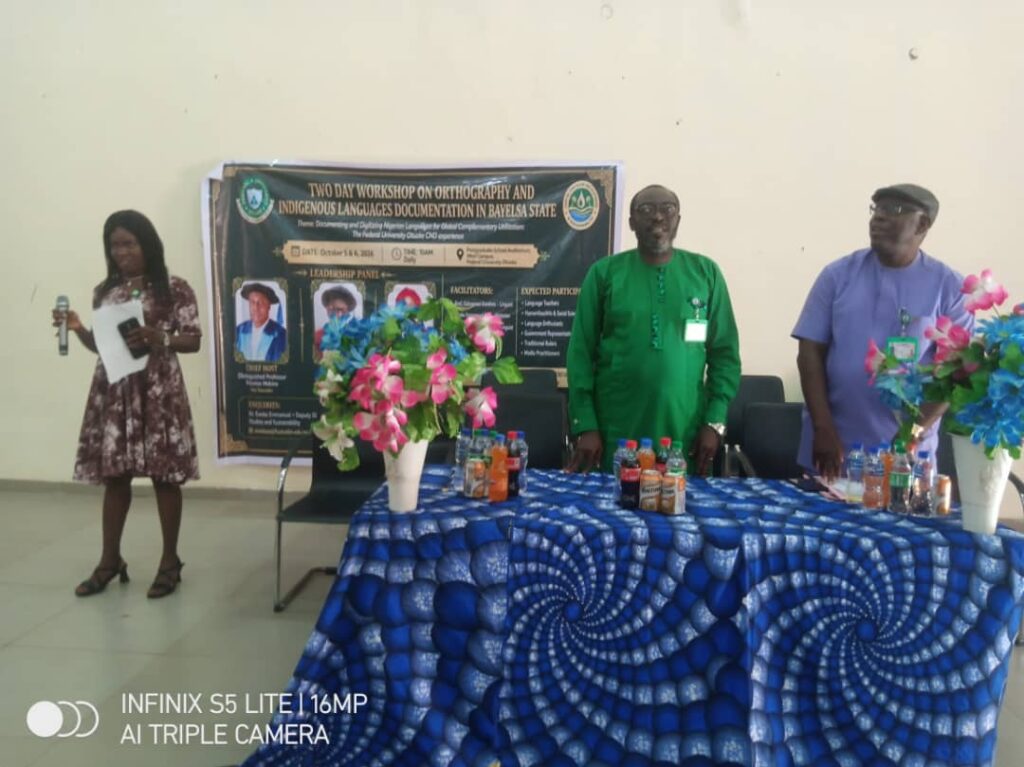
The Centre for Niger Delta Studies and Sustainability, CNDSS, Federal University, Otuoke, FUO, has organised a two-day workshop on orthography and indigenous languages documentation in Bayelsa State.
The workshop, with the theme, “Documenting and Digitizing Nigerian Languages for Global Complementary Utilization: The Federal University Otuoke CNDSS Experience,” was held at the School of Postgraduate Studies Auditorium.
Declaring the workshop open, the Vice-Chancellor, Prof. Promise Mebine, represented by the Dean, Faculty of Humanities, Prof. Stevenson Osakwe Omoera, said the theme was apt and a sign of indigenous capacity to develop local languages for global use.
He stressed the need to discuss how to develop indigenous languages for the benefit of the Niger Delta people and the world at large.
In his welcome address, Director of the Centre, Prof. Kosioma Owede, said language is more than a means of communication, but a repository of the history, culture and identity of a people.
Owede identified globalisation, migration, urbanisation, changing patterns of education, technological transformation and increasing dominance of widely spoken languages as challenges to language development.
He said the mandate of the centre is to preserve languages through learning, research, community engagement, documentation and inter-disciplinary approach.
According to him, the workshop will afford participants the opportunity to examine how to move from the traditional mode of language preservation to an innovative, technology-driven and globally acceptable system of documentation and preservation.
At the panel session, Dr. Eneware Emeketin, an Izon language facilitator of Isaac Jasper Boro College of Education, Sagbama, said he was among those who developed the Izon language curriculum for use in schools in Bayelsa State.
He stressed the urgent need to have Izon language on software, as ringing tones, for content creation in Izon dialect films, and to make students write some semester examinations in the indigenous language as a means of digitisation.
Emeketin listed lack of approved Izon orthography as a major factor militating against language teaching and development in the state.
Mr. Macbere Tovie, an Epie language facilitator, said Epie language orthography has been approved by the National Language Board.
He advised that English words such as cement, engine and others should be translated into local languages, and urged the use of indigenous languages to send SMS and write letters.
He noted that the interest of the learner is key to understanding language and advised parents to speak local languages to their children.
Another panellist, Dr. William Azibaoguanasi of the Department of English and Communication Studies, FUO, observed the growing trend of language teachers relying on government to provide funds to document and preserve language, which according to him, are hardly provided.
He advised them to emulate the late Prof. Kay Williamson who funded language projects from personal savings before receiving support from Brazil, University of Ibadan and UNIPORT, lamenting that even when government releases funds, it is given to officials instead of actual practitioners.
Azibaoguanasi said practitioners should not place emphasis on language preservation only, but also on usage by employing digital devices such as developing indigenous language software, indigenous computer language and social media platform groups.
In the interactive session, Godgift Josiah, a 400-level student of History and International Studies; Prof. Okeke; Dr. Baribor Joel of English and Communication Studies; Head of Department, Theatre and Film Studies, Dr. Divine Sheriff Uchenna Joe; Mrs. Isu, an Ogbia language teacher; Agbalaiko Bethel, Esq; and Sir B.D.F Amangoli, a retired school teacher, among others, asked questions and made contributions on the number of languages recognised in Bayelsa State, lack of indigenous language literature, funding, how to digitise indigenous languages and develop suitable teaching models.
The Convener, Dr. Emmanuel Eweke, an historian and Deputy Director of CNDSS, gave the vote of thanks.
He expressed gratitude to the Vice-Chancellor, Prof. Promise Mebine, for approving the workshop and thanked participants for attending, saying there was much to learn as the programme continued on Tuesday, October 6, 2026.
Students of the Department of Theatre and Film Studies performed a cultural dance to the beats of Awigiri music to entertain participants.