
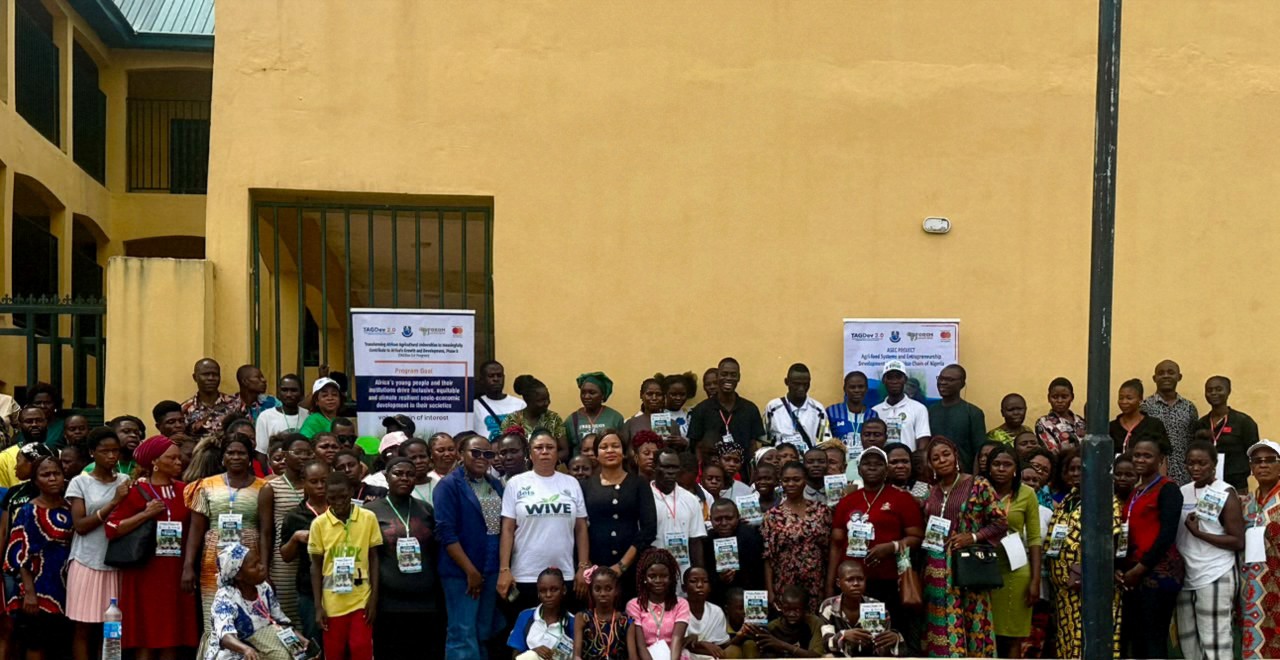
More than 300 youths in Bayelsa State have received practical training in monosex tilapia production under the TAGDev 2.0 Programme of the University of Port Harcourt, in a move aimed at strengthening aquaculture and expanding youth participation in agribusiness.
The training, held from October 21 to 24, 2026, at Akenfa Community School, was organised in partnership with PTADELA Farms Limited, with support from the Regional Universities Forum for Capacity Building in Agriculture (RUFORUM) and the Mastercard Foundation.
It focused on equipping participants with technical and entrepreneurial skills required to establish viable fish farming businesses, improve production efficiency and contribute to food security and employment generation in the Niger Delta.
Participants received practical instruction in pond preparation, hatchery management, fish identification and sorting, feed formulation, feeding management, water quality management and business planning for profitable tilapia production.
The training forms part of efforts by TAGDev 2.0 to connect agricultural education with practical enterprise development, giving young people the skills to participate in the aquaculture value chain.
Speaking during the programme, the TAGDev 2.0 Programme Coordinator at the University of Port Harcourt, Prof. Ibisime Etela, represented by the Officer in Charge of Monitoring, Evaluation and Learning, Dr Chinwe F. Anyanwu, said the initiative was part of efforts to empower youths and vulnerable groups through entrepreneurial skills.
She said the programme sought to equip youths, women, persons with disabilities and internally displaced persons with practical skills that could support self-employment and sustainable livelihoods.
Etela urged participants to apply the knowledge gained during the training, noting that entrepreneurial skills could help them create income-generating opportunities and contribute to the economic development of their communities.
She described TAGDev 2.0 as a 10-year initiative launched in 2023 to advance skills development, enterprise creation and educational opportunities for young people and other target groups.
The Chief Executive Officer and Managing Director of PTADELA Farms Limited, Juliet Amakamoro, said the training would contribute to building local expertise and broadening access to economic opportunities in aquaculture.
Amakamoro, identified as the pioneer aquaculturist trained by the International Fund for Agricultural Development (IFAD) in Bayelsa State, said her organisation had collaborated with sponsors since 2023 to train youths, women and persons with disabilities in agriculture, vocational skills and food processing.
She said the programme focused on people aged between 18 and 35, a group she described as having significant potential to contribute to innovation and employment generation in the agricultural sector.
Amakamoro expressed appreciation to the University of Port Harcourt, RUFORUM and the Mastercard Foundation for supporting the training.
She said the initiative could help strengthen Bayelsa’s position in tilapia production and create opportunities for small and medium-scale aquaculture enterprises.
She added that improved fish strains, appropriate production methods, effective farm management and access to markets were important to improving productivity and profitability.
The Communication Officer of TAGDev 2.0, Chinyelu Irene Nwokolo, said the programme was co-designed by the University of Port Harcourt, supported by RUFORUM and implemented in partnership with the Mastercard Foundation to contribute to the transformation of Nigeria’s agri-food systems.
She said the programme’s targets for 2023–2033 included facilitating 27,900 jobs, supporting 210 enterprises, strengthening the rice and aquaculture value chains and contributing to the planting of one million trees.
According to Nwokolo, the initiative also supports education and vocational training for undergraduate and postgraduate students, out-of-school youths and Technical and Vocational Education and Training (TVET) students. Eligible refugees, internally displaced persons and persons with disabilities are among the groups targeted for educational and skills-development opportunities.
She said the Bayelsa training demonstrated how partnerships between universities, development organisations and private-sector operators could expand access to practical agricultural learning and prepare young people for opportunities in the labour market.
The training also highlighted the potential of aquaculture to improve food security and create employment opportunities in hatchery operations, fish farming, feed production, processing, distribution and marketing.
Some participants expressed appreciation to the organisers and sponsors, saying they were prepared to apply the skills acquired to establish or strengthen their fish farming businesses and share their knowledge with others in their communities.
The organisers expressed optimism that the initiative would encourage young people to see agriculture as a viable business venture capable of generating income, creating jobs and supporting sustainable economic growth.