Doris Ayamaere, Yenagoa
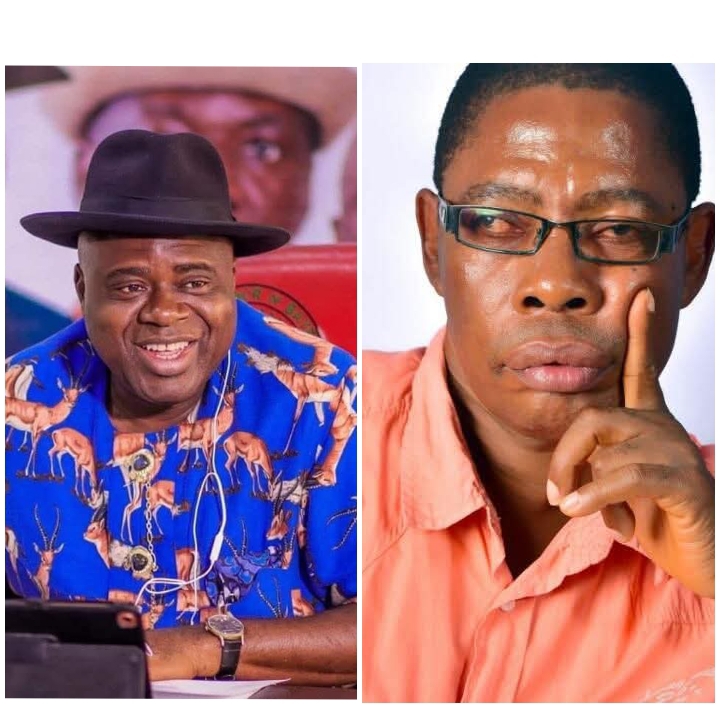
Publisher and Editor-in-Chief of Niger Delta Herald Newspapers, Dr. Francis Dufugha, has said that press criticism must not be allowed to become political propaganda in the debate over development in Bayelsa State.
Dufugha, in a press statement on Friday, said recent criticisms in some sections of the media over the pace and direction of development in the state demand a response, not to shield government from scrutiny, but to ensure public discourse is anchored on facts, evidence and professional journalism.
He said the press has every right and indeed a responsibility to question government policies, interrogate public expenditure and demand accountability, but stressed that the responsibility of the press does not end with criticism.
“It is therefore necessary to ask: Are we reporting Bayelsa as it is, or are some commentators deliberately reporting Bayelsa only from the angle that suits their political narrative?” he queried.
He noted that there is a growing tendency to reduce the development conversation in Bayelsa to what government has allegedly failed to do, while ignoring major projects either completed, ongoing or already commissioned.
He cited major investments by the state government in roads and bridges, urban renewal, a 60MW gas-fired independent power project, the Angiama-Oporoma bridge and other infrastructure projects, adding that the 2026 budget allocated 64.6 per cent of its expenditure to capital projects, with substantial allocations to works, education, health, sports and other sectors.
According to him, these facts do not mean that government should be declared beyond criticism, but that criticism should be based on the whole picture.
“If there are concerns about the cost of a project, journalists should investigate the contract value, procurement process, funding source, level of completion and expected public benefit.
“If there are concerns about poverty and unemployment, the press should obtain and present the relevant data. If government promises have not been fulfilled, the media should ask when the promises were made, what has been delivered and what remains outstanding. That is journalism,” he said.
Dufugha said Bayelsa does not need a situation where every development project is automatically interpreted through a political lens and every government intervention is dismissed before its impact can be objectively assessed.
He said government must be prepared to provide figures, documents, timelines and evidence to justify its claims, answer legitimate questions and accept criticism where projects fail or public resources are not properly utilised.
He however added that the media must equally accept its own responsibility, noting that a journalist is not an opposition politician and a newspaper is not a political party.
“The credibility of the press is measured by its commitment to facts, balance, verification and the public interest,” he said.
He described Bayelsa as a developing state with enormous challenges arising from its difficult terrain, limited connectivity and years of infrastructure deficits, stressing that the state requires sustained development and not perpetual political warfare disguised as journalism.
He said there is nothing wrong with asking whether a road is worth its cost, questioning a stadium project or demanding jobs, food security, better healthcare and improved education, but such questions must be accompanied by facts and not insinuations or political talking points.
Dufugha noted that recent opposition criticisms of the Diri administration have focused on poverty, hunger, unemployment and spending priorities, including criticism of the proposed stadium project, but said those positions remain political claims and should be presented as such rather than automatically treated as established facts.
He added that claims by government about development achievements should also be subjected to independent verification rather than simply reproduced as official propaganda.
“Our people deserve to know what government is doing, what government is not doing, what has worked, what has failed, what has been promised and what has actually been delivered.
“The press must therefore rise above political camps and become the bridge between government and the governed. We should not be afraid to criticise government. But neither should we be afraid to acknowledge development when the evidence shows it.
“Bayelsa belongs to all of us. Its development should therefore be bigger than partisan politics, bigger than personalities and bigger than the interests of any political camp. The duty of the press is to speak truth to power , but truth must remain the standard,” he added.